There was some delay posting about my trip last Saturday because I developed severe cold symptoms that worsened later that day and are still lingering now. However, I was thrilled to have finally gotten an opportunity to tour the Dr. Willella Howe-Waffle House and Medical Museum (NRHP #77000320). The Santa Ana Historical Preservation Society (SAHPS) only opens it up once every other month, so it’s been difficult to schedule. Once there, it was a treat. I had a wonderful docent who showed me around the spacious Late Victorian house, the former residence of early Orange County physicians Alvin and Willella Howe. It sits two blocks away from its original location, rescued from destruction by the SAHPS, which is currently working to save addition historic houses in the area.
Like many other historic houses, Dr. Willella Howe-Waffle’s house is currently furnished with period pieces found elsewhere. The dining room is still used today, tea and other treats being regularly provided for visitors.
The bookshelf, however, is original. It spins around like a lazy-susan.
The house contains a lot of redwood, as can be seen on the attic door. Unfortunately, most of it was painted over in gray when the United States Army used the house as a recruiting station during World War II.
The Drs. Howe were prominent physicians, and Dr. Mrs. Howe’s second husband, Edson Waffle, a prominent livery stable owner. Hence, the family could afford niceties such as beautiful wall trimmings.
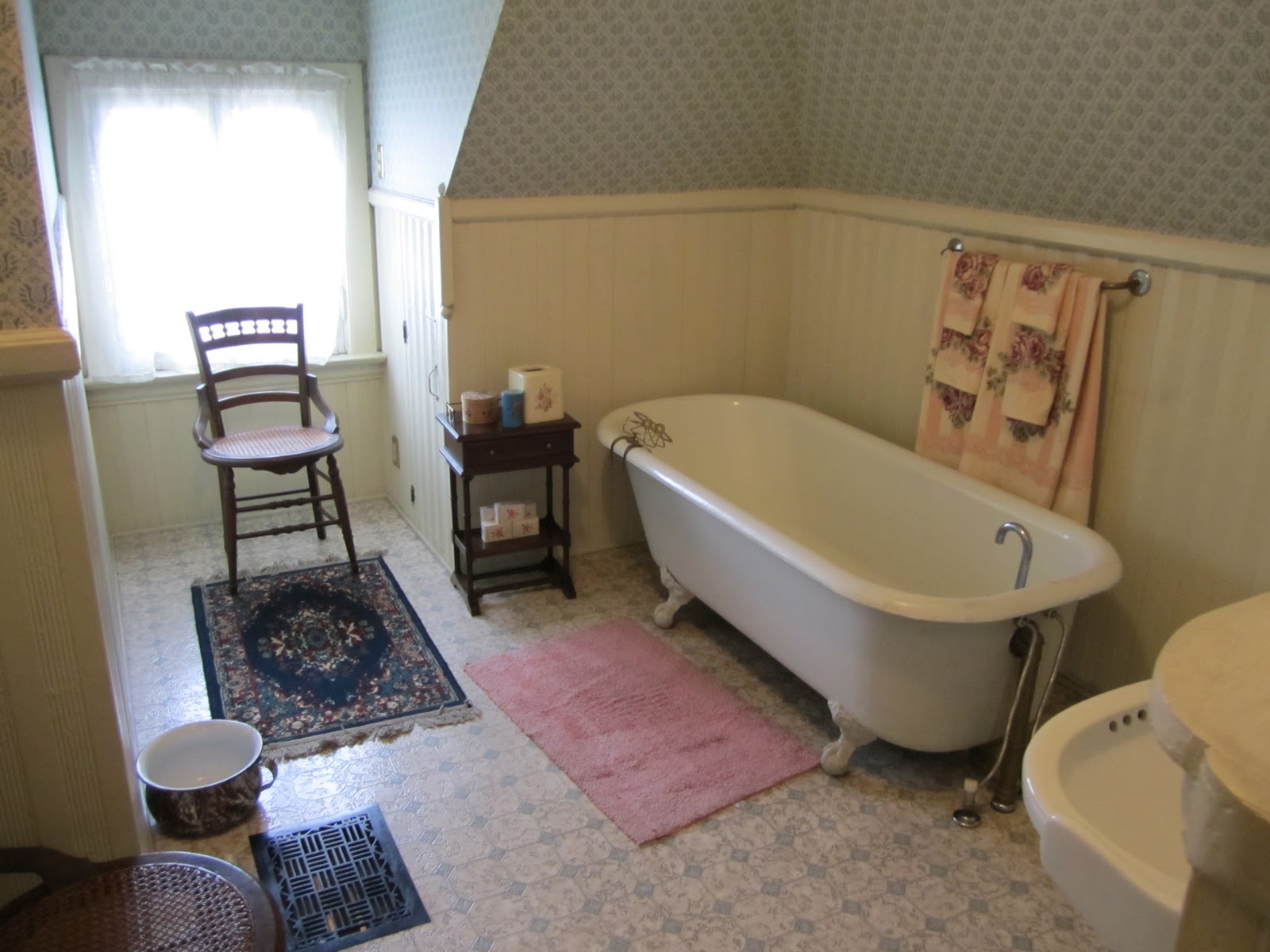
They even had floor heating in the upstairs bathroom via the kitchen, and a porthole window in the mistress’ bedroom closet for light.
Since Dr. Willella Howe-Waffle worked from home, she had an office and supplies to tend to her patients.
Her diplomas and certificates are also on display.
The bill above the wheelchair is for $13.00 worth of services rendered.
The lady doctor even had an “intercom”-like device installed so that late-night callers could wake her to deliver a baby. The yellow speaker peeks out of her bedroom wall.
When patients weren’t quarantined in the attic, they stayed in the carriage house. One of the docents said that the children would often camp out in the courtyard area, which now features a gazebo.
All in all, the Howe-Waffle House is a cute little museum. I hope I won’t have to wait years to see it a second time.
Showing posts with label CA-OC. Show all posts
Monday, April 4, 2011
Thursday, March 31, 2011
03-30-11: Mission San Juan Capistrano
Yesterday, I commenced my mission to visit all of the Orange County sites listed in the National Register of Historic Places, some which are also California Historical Landmarks. It was fitting to begin with Mission San Juan Capistrano (CHL #200, NRHP #71000170), seventh in the chain of Franciscan missions here in Alta California, named for an Italian crusader. It holds the distinction of having been founded twice, once in 1775 by Padre Fermín Lasuén and revived in 1776 by Padre Junipero Serra, to serve the Acagchemem (Juaneño) Indian population. The mission declined during the later Spanish colonial period and was all but abandoned after Mexico secularized it. However, in 1865, under the United States, control reverted back to the Roman Catholic Church, and the long restoration process began.
Like other Orange Countians, I’ve visited the mission a number of times, including within the last year. But this time was unique because I saw the mission entirely through a camera lens, that is, viewfinder. The second picture (below) depicts the “Apostle of California” embracing a Juaneño boy, a tribute to the early proselytizing efforts and the site’s continued educational role as a popular field trip stop and parochial school location. In the background are the ruins of the Great Stone Church, destroyed by the 1812 earthquake. Unfortunately, the sun was in a terrible spot for photographing the inside.
Recently, a docent pointed out two spots of paint remains that had largely gone unnoticed by visitors. [Edit - I've been informed that it's oxidized copper. Duh! Sorry about that.] I was happy to have caught both on camera.
The crows finally cooperated for a shot with the infamous church bells.
And for once, the cemetery was empty and quiet. The large marker (foreground left) is for Monsignor Saint John O'Sullivan, the man responsible for leading much of the restoration efforts. The tombstone (background center) is for Don José Antonio Yorba I, a member of Gaspar de Portolà’s 1769 expedition. I – along with maybe 0.75 million other people – live on his Rancho Santiago de Santa Ana, better known today as Central Orange County.
The original 1782 church features a beautiful Baroque alter imported from Spain along with hundreds of restored paintings and other decorations. Yesterday, as usual, there was someone kneeling at prayer. The chapel certainly isn’t at risk of losing its standing as the oldest building in California continuously being used.
Here are some pictures of the beautiful grounds enclosed by the chapel, barracks, kitchens, and storerooms.
The basilica’s main rotunda and bell tower (background left) can be seen beyond. Built in 1984, the Mission Basilica now features a stunning new gold retablo, but I haven’t had a chance to see it yet. (I personally preferred its minimalist old look, but it’s now probably a more accurate copy of the Great Stone Church.)
Archaeological excavations in 1935 uncovered evidence of early industry during the mission period. The tallow cooking stoves were used to melt beef fat, eventually turning it into a more functional form useful for making household products.
In 1988, the metalworking furnaces, the oldest in the state, became an ASM Historical Landmark. The site introduced the production of wrought iron to an exclusively stone-age culture.
This mission is the site of Alta California’s first winery, the Criollo grape having been planted there. Although this wine vat might look like it’s outside, excavations in the 1980s have shown that it was once an indoor stomping ground.
That about wraps up my latest visit to the mission. It’s a stop on future tours, so more will come as things progress.
Like other Orange Countians, I’ve visited the mission a number of times, including within the last year. But this time was unique because I saw the mission entirely through a camera lens, that is, viewfinder. The second picture (below) depicts the “Apostle of California” embracing a Juaneño boy, a tribute to the early proselytizing efforts and the site’s continued educational role as a popular field trip stop and parochial school location. In the background are the ruins of the Great Stone Church, destroyed by the 1812 earthquake. Unfortunately, the sun was in a terrible spot for photographing the inside.
Recently, a docent pointed out two spots of paint remains that had largely gone unnoticed by visitors. [Edit - I've been informed that it's oxidized copper. Duh! Sorry about that.] I was happy to have caught both on camera.
The crows finally cooperated for a shot with the infamous church bells.
And for once, the cemetery was empty and quiet. The large marker (foreground left) is for Monsignor Saint John O'Sullivan, the man responsible for leading much of the restoration efforts. The tombstone (background center) is for Don José Antonio Yorba I, a member of Gaspar de Portolà’s 1769 expedition. I – along with maybe 0.75 million other people – live on his Rancho Santiago de Santa Ana, better known today as Central Orange County.
The original 1782 church features a beautiful Baroque alter imported from Spain along with hundreds of restored paintings and other decorations. Yesterday, as usual, there was someone kneeling at prayer. The chapel certainly isn’t at risk of losing its standing as the oldest building in California continuously being used.
Here are some pictures of the beautiful grounds enclosed by the chapel, barracks, kitchens, and storerooms.
The basilica’s main rotunda and bell tower (background left) can be seen beyond. Built in 1984, the Mission Basilica now features a stunning new gold retablo, but I haven’t had a chance to see it yet. (I personally preferred its minimalist old look, but it’s now probably a more accurate copy of the Great Stone Church.)
Archaeological excavations in 1935 uncovered evidence of early industry during the mission period. The tallow cooking stoves were used to melt beef fat, eventually turning it into a more functional form useful for making household products.
In 1988, the metalworking furnaces, the oldest in the state, became an ASM Historical Landmark. The site introduced the production of wrought iron to an exclusively stone-age culture.
This mission is the site of Alta California’s first winery, the Criollo grape having been planted there. Although this wine vat might look like it’s outside, excavations in the 1980s have shown that it was once an indoor stomping ground.
That about wraps up my latest visit to the mission. It’s a stop on future tours, so more will come as things progress.
Saturday, March 26, 2011
Missions 1 & 2 Commence
Back in September, on my main blog, I posted “More Burger for Your Buck,” a brief commentary on the moral and economic success of the Christian-owned In-N-Out Burger chain restaurants. Although I am aware that there are die-hard Chick-Fil-A fans in the Christian community, I’ll continue to argue that doing good for one’s customers and workers is far more important than observing the Sabbath.
Okay, now my point. Two weeks ago, I decided on what three travel/tour missions I’d tackle first. Number one is dragging along my brother to eat at every In-N-Out Burger joint in existence, which shouldn’t be too, too difficult since 78% of the locations are in my home state. But I’m not setting deadline anyway. Who knows how many new stores will pop up during the course of my mission. Last stop, if they let us, will be the Irvine headquarters, which by the way is near the UCI location, the one with probably the best In-N-Out service I’ve ever experienced. And that’s saying a lot. What to do about restricted sites? I don't know.
Number two is visiting all of the Orange County sites listed in the National Register of Historic Places. I’ll probably expand to all of California later, but this will work for now. Hopefully, the National Park Service won’t add new ones faster than I can complete them.
What’s number three? One that I’ll need to work out more before it’s revealed. Stay tuned!
Okay, now my point. Two weeks ago, I decided on what three travel/tour missions I’d tackle first. Number one is dragging along my brother to eat at every In-N-Out Burger joint in existence, which shouldn’t be too, too difficult since 78% of the locations are in my home state. But I’m not setting deadline anyway. Who knows how many new stores will pop up during the course of my mission. Last stop, if they let us, will be the Irvine headquarters, which by the way is near the UCI location, the one with probably the best In-N-Out service I’ve ever experienced. And that’s saying a lot. What to do about restricted sites? I don't know.
Number two is visiting all of the Orange County sites listed in the National Register of Historic Places. I’ll probably expand to all of California later, but this will work for now. Hopefully, the National Park Service won’t add new ones faster than I can complete them.
What’s number three? One that I’ll need to work out more before it’s revealed. Stay tuned!
Subscribe to:
Posts (Atom)